







Projects and Experiment: This page is a really a legacy from the original site as activities are now mostly on other platforms. The links are available to YouTube, Facebook and others on the banner above.
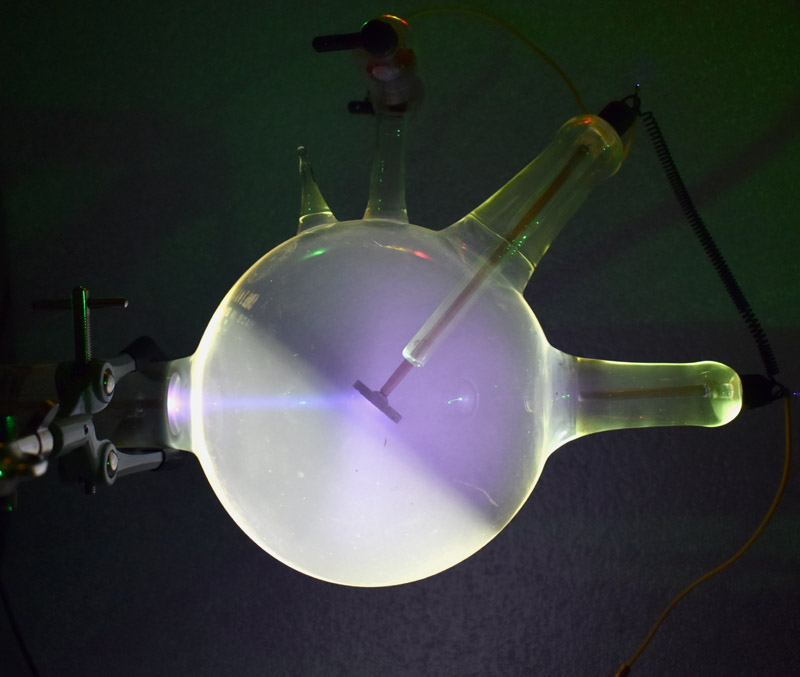
High Voltage and X-rays: These keep coming up with different projects and activities so remain as a heading here. Both these topics have associated dangers and these are sometimes discussed. (1) This is a cold cathode 'Crookes' X-ray tube. These relied on a small residual gas reservoir to control the operation and X-rays. They required very high voltages of 100kV and up to operate so produced very penetrating x-rays. Follow the picture-link for more:
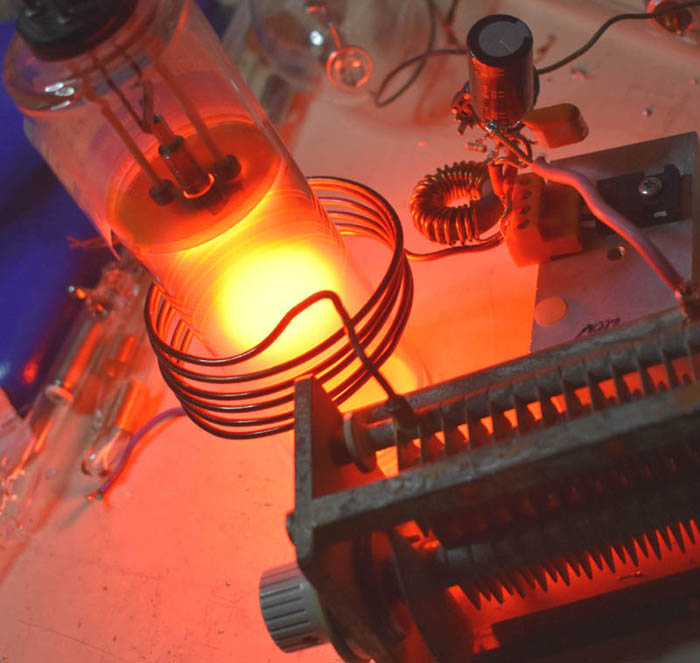
Some other interesting topic (2) This is a RF MOSFET driven resonant LC circuit running from about 12V. Voltages in the coil and capacitor are high enough to excite the neon in the tube. Other projects such as the Scintillation PMT for radiation detection.
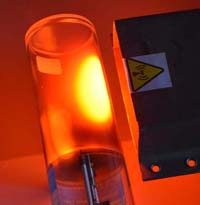
Radiation detection (3) is an interesting area and one type uses a plastic scintillator as shown here in front of 2 photomultiplier tubes. Follow the picture-link for more on radiation detectors:
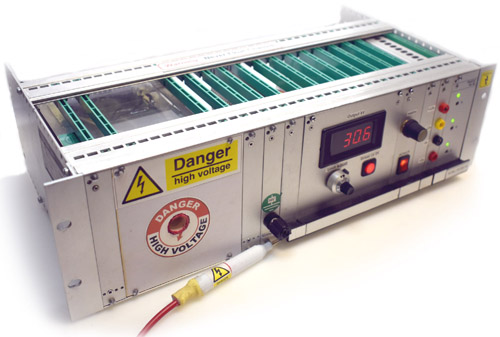
(4)There seems to be no end to the need for high voltage supplies. This one has been constructed to produce plus 0 - 70kV at around 3mA. The design is based on a small x-ray supply with a modified voltage multiplier. The HV transformer runs at 28kHz. There is also a low voltage supplies built in use with cathode heaters and the likes.
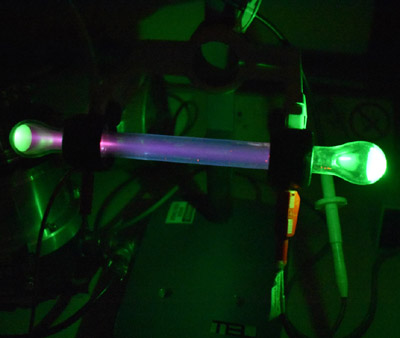
Image number (5) is of an educational vacuum tube and forms a nice experiment. Seen here the tube has been pumped down to quite a low pressure and a voltage of around 18kV is applied between the two electrodes in the dark areas along the tube, these are metal disks with a slot in the centre. They are both the same but form the cathode and anode by polarity. As shown here the anode is the right most electrode. The two end-bulbs have internal fluorescent coatings seen glowing green. The anode end, on the right, is glowing from electron bombardment and has the image of the slit in the anode on it. The fluorescent coating on the other end is also glowing and this is behind the cathode so must be by positive rays. These were once known as 'Canal-rays' but are now known as ions. As the vacuum is not perfect some light is visible in the tube from gas discharge with the remaining air molecules. This dims as the vacuum hardens but the voltage needs to be increased to keep the fluorescence glowing and above 20kV X-rays emission start to be detectable. This is a great demonstration contained in one tube.
Image (6) is just a bit of two conductor flat mains lighting flex, but it is being stressed with a high voltage, high frequency supply. The voltage is not causing too much stress, but the high frequency is. Corona discharge is forming across the dielectric in air and producing this blue glow. There is also a UV content which is fluorescing the paper its on too.
Image (7) is from the 'Flashing Light Prize.' I particularly liked this one, as the flash is generated by an under-run magnetron. The low resistance of the ionized neon created by the microwave emission is being used to switch the magnetron off. As a result the neon flashes. The images is linked to more on this experiment.
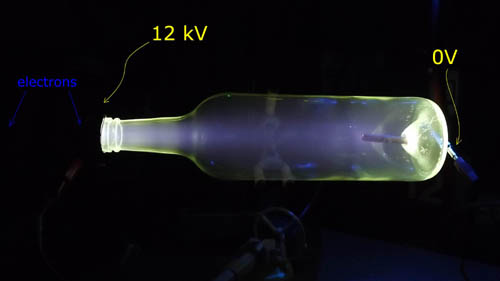
Image (8) is from the 'Lenard Rays.' now known as Beta radiation or high energy electrons. The bottle used in this experiment has a vacuum being drawn while there is a 12kV voltage applied to the metal cap. There are holes drilled into the cap like a pepper pot and a thin sheet of aluminium over them to keep the vacuum. Electrons are being accellerated by the voltage from the cathode into the cap. some are hitting the cap hard enough to imerge into the air. These electrons have enough energy to travel a few centimetres in air, and can be detected with a G-M counter. The vacuum is hard enough for the glass to be seen glowing with the interactions of electrons. X-rays are also generated with this process.
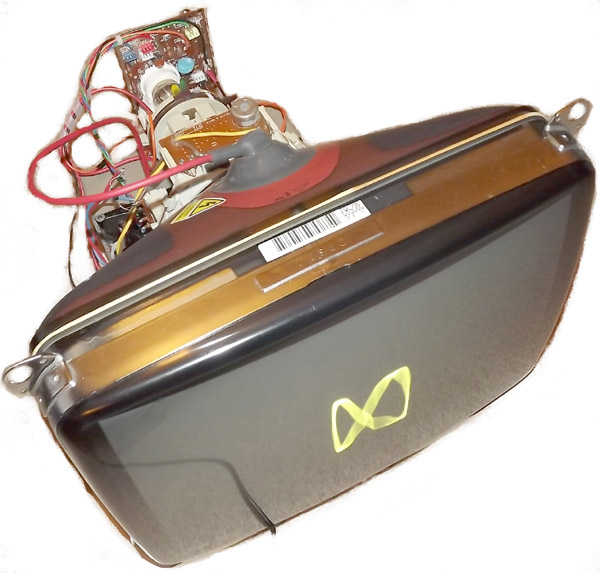
(9) Lissajuos figures shown using an old colour TV CRT. This technique was once used to compair and measure different frequencies using oscilloscopes. It is possible to do it with electromagnetic deflection and create an interesting and colourful dispaly.

